Wednesday, August 5, 2009

Quote: Take not from the mouth of labor the bread it has earned — Thomas Jefferson


Whistleblower tells of America's hidden nightmare for its sick poor

Paul Harris, The Observer, Sunday, July 26, 2009

When an insurance firm boss saw a field hospital for the poor in Virginia, he knew he had to speak out. Here, he tells Paul Harris of his fears for Obama's bid to bring about radical change
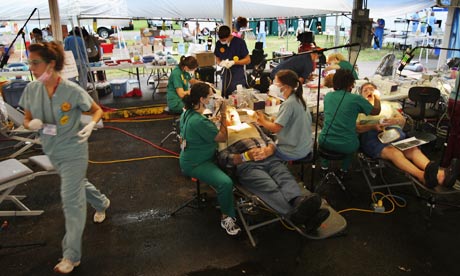

Dental care at a clinic in Wise Virginia

Patients without health insurance get dental care at a free clinic in Wise, Virginia, held every July for the past three years. More than 25,000 were treated in a weekend Photograph: John Moore/Getty Images

Wendell Potter can remember exactly when he took the first steps on his journey to becoming a whistleblower and turning against one of the most powerful industries in America.

It was July 2007 and Potter, a senior executive at giant US healthcare firm Cigna, was visiting relatives in the poverty-ridden mountain districts of northeast Tennessee. He saw an advert in a local paper for a touring free medical clinic at a fairground just across the state border in Wise County, Virginia.

Potter, who had worked at Cigna for 15 years, decided to check it out. What he saw appalled him. Hundreds of desperate people, most without any medical insurance, descended on the clinic from out of the hills. People queued in long lines to have the most basic medical procedures carried out free of charge. Some had driven more than 200 miles from Georgia. Many were treated in the open air. Potter took pictures of patients lying on trolleys on rain-soaked pavements.

For Potter it was a dreadful realisation that healthcare in America had failed millions of poor, sick people and that he, and the industry he worked for, did not care about the human cost of their relentless search for profits. "It was over-powering. It was just more than I could possibly have imagined could be happening in America," he told the Observer

Potter resigned shortly afterwards. Last month he testified in Congress, becoming one of the few industry executives to admit that what its critics say is true: healthcare insurance firms push up costs, buy politicians and refuse to pay out when many patients actually get sick. In chilling words he told a Senate committee: "I worked as a senior executive at health insurance companies and I saw how they confuse their customers and dump the sick: all so they can satisfy their Wall Street investors."

Potter's claims are at the centre of the biggest political crisis of Barack Obama's young presidency. Obama, faced with 47 million Americans without health insurance, has put reforming the system at the top of his agenda. If he succeeds, he will have pushed through one of the greatest changes to domestic policy of any president. If he fails, his presidency could be broken before it is even a year old. Last week, in a sign of how high the stakes are, he addressed the nation in a live TV news conference. It is the sort of event usually reserved for a moment of deep national crisis, such as a terrorist attack. But Obama wanted to talk about healthcare. "This is about every family, every business and every taxpayer who continues to shoulder the burden of a problem that Washington has failed to solve for decades," he told the nation.

Obama's plans are now mired and the opponents of reform are winning. The Republican attack machine has cranked into gear, labelling reform as "socialist" and warning ordinary Americans that government bureaucrats, not doctors, will choose their medicines. The bill's opponents say the huge cost can only be paid by massive tax increases on ordinary Americans and that others will have their current healthcare plans taken away. Many centrist Democratic congressmen, wary of their conservative voters, are wavering. The legislation has failed to meet Obama's August deadline and is now delayed until after the summer recess. Many fear that this loss of momentum could kill it altogether.

To Potter that is no surprise. He has seen all this before. In his long years with Cigna he rose to be the company's top PR executive. He had an eagle-eye view of the industry's tactics of scuppering political efforts to get it to reform. "This is a very wealthy industry and they use PR very effectively. They manipulate public opinion and the news media and they have built up these relationships with all these politicians through campaign contributions," Potter said.

Potter was witness to the campaign against Michael Moore's healthcare documentary Sicko. The industry slammed the film as one-sided and politically motivated. Secret documents leaked from the American Health Insurance Plans, the industry's lobby group, detailed the plan to paint Moore as a fringe radical. Potter now says the film "hit the nail on the head". "The Michael Moore movie that I saw was full of truth," he admits.

Potter was also working for Cigna when it became embroiled in the case of Nataline Sarkisyan, whose family went public after Cigna refused to pay for a liver transplant that it considered "experimental" and therefore not covered by their policy. Cigna reversed this decision only hours before the Californian teenager died. "I wish I could have done more in that case," Potter said.

Such sentiments are rare in an industry that has given America a healthcare system that can be cripplingly expensive for patients, but that does not produce a healthier population. The industry is often accused of wriggling out of claims. Firms comb medical records for any technicality that will allow them to refuse to pay. In one recently publicised example, a retired nurse from Texas discovered she had breast cancer. Yet her policy was cancelled because her insurers found she had previously had treatment for acne, which the dermatologist had mistakenly noted as pre-cancerous. They decreed she had misinformed them about her medical history and her double mastectomy was cancelled just three days before the operation.

Last month three healthcare executives were grilled about such "rescinding" tactics by a congressional subcommittee. When asked if they would abandon them except in cases of deliberately proven fraud, each executive replied simply: "No."

To Potter that attitude has a sad logic. The healthcare industry generates enormous profits and its top executives have a lavish corporate lifestyle that he once shared. Treating patients for their expensive conditions is bad for business as it reduces the bottom line. Kicking out patients who pursue claims makes perfect economic sense. "It is a system that is rigged against the policyholder," Potter said. The congressional probe found that just three firms had rescinded more than 20,000 policyholders between 2003 and 2007, saving hundreds of millions. "That's a lot of money that will now go towards their profits," Potter said.

A lot of that money also goes into contributions to politicians of both parties - $372m in the past nine years - and in lobbying groups to run TV ads slamming Obama's plans. Many of these ads deploy naked scare tactics. One report said that the industry was spending $1.4m a day on its campaign. In the face of that, it is perhaps no wonder that the Senate has delayed its vote, dealing a massive blow to Obama. "I have seen how the opponents of healthcare reform go to work... they are trying to delay action. They know that if they keep the process going for months, and turn it into a big mess, then the political impetus behind it will lessen," Potter said.

Potter, who now works at the Centre for Media and Democracy in Wisconsin, says the industry is afraid of Obama's reforms and that is why it is fighting so hard. It wants to deal him the same blow as it did Bill Clinton when it scuppered his attempt at reform in the 1990s. Potter admits that he is worried the industry might win again. "I have seen their tactics work. I have been a part of it," he said. He knows he has no chance of ever working again for a major firm. "I am a whistleblower and corporate America does not tend to like that," he said. But there is one thing Potter is not sorry about: leaving the healthcare industry and speaking out. "I have absolutely no regrets. I am doing the right thing," he said.

Comprehensive healthcare reform in the US has been an ambition of many presidents since the early part of the 20th century. None has succeeded in creating a system that gives all Americans the right to coverage. Barack Obama, below, is desperate to avoid the same fate.

Finding a cure

What is the current system?
It is a complex mish-mash of systems. Millions of Americans have their own private healthcare plans, either individually or through their employer. About 47 million Americans have none. However, systems do exist to cover the very poor and the old. The system is fiendishly complex and full of loopholes, so even those with coverage can have it withdrawn.

How bad is it?
US hospitals are the best in the world if you can afford them. Many cannot, and an accident or sudden illness can often bankrupt someone.

How does it compare with other countries?
It depends how you measure things. The US spends about 16% of GNP on healthcare, far more than France and Germany, which spend 11 to 12%. Yet those countries provide universal care.

What is the biggest problem?
Critics say the biggest issue is the profit motive that drives US healthcare. This ensures that costs are always rising as the incentive is there to provide expensive treatment. It also gives health insurers the incentive to refuse treatment to claimants, by seeking to withdraw their cover.

What is Obama's solution?
Obama has asked Congress to draw up a government option, allowing all Americans to get some sort of cover. The sheer size of the state plan should theoretically allow it to drive down costs by economies of scale.

What's happening now?
Obama has put his reputation on the line to persuade wavering Democrats and moderate Republicans to vote on legislation by August. The Senate has said this will not happen. That's a major blow, as it puts off the debate until September and could see the political momentum stall.

Bankruptcy: The healthcare connection

Medical problems were behind two-thirds of personal bankruptcies in 2007. And that was before the economic crisis.

Andrew Leonard

Jun. 05, 2009 |

Americans filed for bankruptcy at a rate of 6,020 per day in May, reports Credit Slip's Bob Lawless. That's the first time the 6,000-per-day mark has been broken since the passing of the 2005 bankruptcy law, which made it hard for Americans to seek relief from their debts.

In related bankruptcy news, the results of a study to be published in the August issue of the American Journal of Medicine show that "medical problems contributed to nearly two-thirds (62.1 percent) of all bankruptcies in 2007." More strikingly -- "between 2001 and 2007, the proportion of all bankruptcies attributable to medical problems rose by 49.6 percent." (Found via Mark Thoma.

The authors of the study cite their findings as yet more evidence that the healthcare system in the United States is broken.

Dr. Deborah Thorne, associate professor of sociology at Ohio University and study co-author, stated: "American families are confronting a panoply of social forces that make it terribly difficult to maintain financial stability -- job losses and wages that have not kept pace with the cost of living, exploitation from the various lending industries, and, probably most consequential and disgraceful, a health care system that is so dysfunctional that even the most mundane illness or injury can result in bankruptcy. Families who file medical bankruptcies are overwhelmingly hard-working, middle-class families who have played by the rules of our economic system, and they deserve nothing less than affordable health care."

We don't know what factors directly accounted for 2009's swelling bankruptcies -- obviously, you don't need the impetus of a serious medical problem to push you into bankruptcy when you've lost your job and your home because of a cratering economy. But it's also safe to assume that a significant number of people who might have been able to afford their healthcare no longer can, given the current economic circumstances. So I think Thoma is right to wonder "how much a health care plan that protects people from losing everything when serious illness hits would have helped to soften the economic crisis."

-- Andrew Leonard

FOR IMMEDIATE RELEASE
August 4, 2009

Contact:
Robert Zirkelbach
(202) 778-8493

AHIP Statement on Status of Health Care Reform

Washington, DC – Karen Ignagni, President and CEO of America’s Health Insurance Plans (AHIP), gave the following remarks at a media teleconference this morning:

“At this point in the summer of 2009, the country should be in the midst of a transformative national conversation about health care reform. Instead, a campaign has been launched to demonize health plans and the men and women who work hard every day in their communities to provide health insurance coverage to more than 200 million Americans.

“For a country that is trying to accomplish what it has failed to do for a century – pass health care reform – the same old Washington politics of ‘find an enemy and go to war’ is a major step backward, not a step forward. Indeed, this is the playbook of consultants, not consensus.

“Attacking our community will not help get anyone covered, nor will it help our country bend the cost curve and make care more affordable for working families and small businesses. These are the issues that should be the focus of a national conversation this summer. That is what the country expected. Not politics as usual, but an effort to forge the consensus that will be necessary to get reform passed.

“For our part, we will set the record straight about our community’s contribution to the reform effort. It was with the hope of helping to create a more constructive climate that health plans began three years ago to develop a set of reform proposals linked by common themes – to build on the strengths of the current system, provide all Americans with health security, ensure that no one falls through the cracks, and put the entire health care system on a financially sustainable path.

“In recent days, policymakers have embraced health insurance reform – the concept we proposed in 2008. Health plans were the first of the stakeholders to come to the table with a comprehensive proposal to reform our own sector. Our proposal brings everyone into the system, guarantees coverage for all Americans, does away with pre-existing condition limitations, and ends rating based on health status and gender.

“We also pledged to earn a seat at the table and our members have been good faith participants in every significant reform effort involving stakeholders from across the spectrum.

“That did not mean that we would sit at any table in silence when confronted with proposals we knew to be flawed. For months, we have explained why we believe a government-run plan would dismantle employer-based coverage, bankrupt local hospitals, and break the promise that if you like your present coverage, you can keep it.

“A government-run plan would inevitably rely on its price-setting ability to offer artificially low premiums – effectively subsidized by the private sector through cost shifting. This would force employers to drop their coverage, creating a death spiral for private insurance and financial catastrophe for many hospitals and doctors.

“Physicians, hospitals, employers, and concerned citizens have joined us in voicing these concerns. As the American people have learned the facts, support for a government-run plan has plummeted. In response, there has been an all-out effort to make support of a government-run program the litmus test for reform.

“If the intent is to place the nation on a path to a single-payer system, as some have recently acknowledged, then that question should be debated candidly and openly.

“We believe that is not the path that the American people support. Instead, they want policymakers to recognize that neither the government nor the private sector can fix health care alone and that the stakes are too high to revert to the usual Washington poll-driven playbook that has been a barrier to progress and could create another missed opportunity to achieve health care reform.

“The country is at a critical juncture. August will be the month when the country decides whether it supports reform and what shape it should take. It is crucial that the American people understand the broad consensus that exists on the essential building blocks for bipartisan reform.

“With that in mind, there are five facts we believe all Americans should know:

  • Health plans have proposed comprehensive health care reform to cover all Americans, make care more affordable, and improve quality.

  • Health plans proposed health insurance reform last year.

  • Health plans have proposed far-reaching initiatives to bend the health cost curve and make care more affordable for individuals, families, and employers.

  • Health plans are advocating and advertising in support of bipartisan reform.

  • Out of every dollar the nation spends on health care, one penny goes to health plan profits.

“Our community includes thousands of dedicated, conscientious Americans who are working hard across the country to try and improve health care. They are ordinary Americans from all walks of life who are raising their families and contributing to their communities. They do not deserve to be demonized or vilified as part of a campaign to distract attention away from the sinking support for a government-run program.”

###

Providing Health Benefits for Over 200 Million Americans.

(click map to enlarge.-java)

The United States spends on average $6,402 per person annually on medical care. France spends about half that — while providing better maternity benefits and complete coverage for people with conditions such as diabetes and cancer. Compare the systems.

CorrectionIn an interview, we said, "And when Germany became a nation in the 1880s, one of the first big things that the government did was to unite all of these what they call sickness funds into one system." In fact, Germany became a nation in 1871.

July 3, 2008

Mention European health care to an American, and it probably conjures up a negative stereotype — high taxes, long waiting lines, rationed care.

It's not that way in Germany. Very little tax money goes into the system. The lion's share comes, as in America, from premiums paid by workers and employers to insurance companies.

German health benefits are very generous. And there's usually little or no wait to get elective surgery or diagnostic tests, such as MRIs. It's one of the world's best health care systems, visible in little ways that most Germans take for granted.

Checking In With An Old Friend

Juergen in der Schmitten was a medical student when I first met him 17 years ago. Now, he's a 42-year-old general practitioner in a suburb of Dusseldorf.

On one particular night, Juergen was the doctor on call for the region. Any German who needs after-hours care can call a central number and get connected to a doctor.

Around 11 p.m., a woman with a fever called Juergen. She wanted him to make a house call. They talked for maybe five minutes, in the end agreeing that she would come into his office in the morning.

A situation like this would be unlikely in the United States. Americans might not get through to a doctor at all, let alone have a discussion about whether the physician should make a house call in the middle of the night to treat a case of flu.

The Patients' Perspective

Sabina and Jan Casagrandes say they've had really good care from the German health system. And they've used it a lot.

Sabina is American, Jan is German. They live in a fourth-floor walkup with their two little girls in Cologne, an ancient city on the Rhine in western Germany.

"I've probably been very expensive for the health insurance system here," Sabina says. "When I was 33 years old, I had a giant lump on my neck all of a sudden, where your thyroid is. And it was a big tumor."

It took two operations to remove her cancer. Luckily it was curable with surgery and radiation. Sabina says she had the best care she could imagine.

"Then I came home to my little daughter, who I couldn't really lift up because of my neck having been cut open," Sabina says. "So I asked my doctor, 'What can I do?' And she said, 'Well, your health insurance will pay for someone to come help you in the house.'"

Sabina's health insurer paid a friend to shop, cook and even help care for the baby until Sabina was back on her feet. That's not unusual in Germany. In fact, under the country's system for long-term care, family members can choose to be paid for taking care of a frail elder at home if they want to avoid nursing home care.

Coverage For All

The health care system that took such good care of Sabina is not funded by government taxes. But it is compulsory. All German workers pay about 8 percent of their gross income to a nonprofit insurance company called a sickness fund. Their employers pay about the same amount. Workers can choose among 240 sickness funds.

Basing premiums on a percentage-of-salary means that the less people make, the less they have to pay. The more money they make, the more they pay. This principle is at the heart of the system. Germans call it "solidarity." The idea is that everybody's in it together, and nobody should be without health insurance.

"If I don't make a lot of money, I don't have to pay a lot of money for health insurance," Sabina says. "But I have the same access to health care that someone who makes more money has."

But she acknowledges that nearly 8 percent of her salary is a sizable bite.

"Yes, it's expensive. You know, it's a big chunk of your monthly income," Sabina says. "But considering what you can get for it, it's worth it."

Actually, it's about the same proportion of income that American workers pay, on average, if they get their health insurance through their job. The big difference is that U.S. employers pay far more, on average, than German employers do — 18 percent of each employee's gross income versus around 8 percent in Germany.

More Added Benefits In Germany

Moreover, German health insurance has more generous benefits than U.S. policies cover. There are never any deductibles, for instance, before coverage kicks in. And all Germans get the same coverage.

For instance, the Casagrandes' insurance covers an expensive medicine Jan needs for a chronic intestinal problem. He says if they moved to America, they might not be able to buy insurance at all because of their pre-existing conditions — a nonproblem in Germany.

"He says for himself — or for us — the health care system in the United States is the major reason why we have never moved there, and never will move there. Because both of us have chronic illnesses that have to have a lot of medical attention, and we would go broke," Sabina says, translating for Jan.

Jan adds something else. "It's also the No. 1 reason in the United States that people personally go bankrupt," Sabina translates, "which would never happen here ... never!"

Coverage For The Family

On the other side of Germany, in Berlin, we meet another couple who know both the American and German health systems.

Nicole and Chris Ertl own Tip Toe Shoes, a children's shoe shop in a well-off area of the German capital. The Ertls sell high-quality European shoes — tiny Italian sandals, French and Danish boots and clogs in wonderful colors.

Chris is from San Diego, Nicole is German. She also works part time as a physician therapist and gets her health care through her job like the great majority of Germans. Like the Casagrandes, she's happy with her coverage.

"It's a good deal!" she says. "It's really good because it's a package."

It's a package many Americans might envy. Nicole pays a premium of $270 a month for insurance that covers her children, too. Nicole pays a single $15 copayment once every three months to see her primary-care doctor — and another $15 a quarter to see each specialist, as often as she wants. She pays no copayments for her children's care —-and her insurance even covers her daughter's orthodontia bill.

"They always have good care," Nicole says, "because for kids, everything is free. The drugs, it's always free" until they turn 18.

Different Rules For The Self-Employed

But even though her insurance covers the kids, it doesn't cover her husband. Because Chris Ertl is self-employed, he has to buy insurance on his own, from a for-profit insurance company.

About one in 10 Germans buy this so-called "private" coverage. It's not just for people who are self-employed. Civil servants and anyone who makes more than $72,000 a year can opt out of the main system. It's a kind of safety valve for people who want more and can pay for it.

But most people don't opt out. Chris says that's because there's a fundamental difference in the way Germans view health care and the government's role — which, in Germany, means refereeing the system and making sure it's fair and affordable.

"The general opinion in Germany is always that the government will do it for us, everything will be OK," Chris says. "In the States, I think you grow up knowing that no one's going to help you do anything. If you want health care, go get it."

It's important to remember that the German government doesn't provide health care or finance it directly. It does regulate insurance companies closely — the nonprofits in the main system and the for-profits where Chris gets his coverage. So Chris' insurer can't raise his rates if he gets sick or jack up his premiums too much as he gets older. The government also requires insurers to keep costs down so things don't get too expensive.

"Where am I better off medically?" Chris says. "I would probably say Germany."

In some ways, Chis Ertl's coverage is better than his wife's. He gets his choice of top doctors — the chief of medicine, if he wants. If he goes into the hospital, he gets a private room. When he goes to the doctor, he gets a free cup of coffee and goes to the head of the line. All this embarrasses him — and annoys Nicole.

"When he goes to the doctor, he has a lot more service," she complains.

Germans really hate any hint of unfairness in health care. The fundamental idea is that everybody must be covered and, preferably, everybody should get equal treatment. So the fact that 10 percent or so can buy some perks is an irritant — something Germans complain about but manage to put up with.

But it's unthinkable that 48 million people wouldn't have health insurance at all — the situation in America. As an American, Chris thinks that's shameful. "It's terrible," he says. "It's unbelievable. It shouldn't happen."

Germans, he says, would never tolerate that. And their system has been working pretty well for 125 years.

Radio piece produced by Jane Greenhalgh.

I don't think politics has anything to do with left, right, or center. It has to do with trying to do right by people. --Paul Wellstone


Crooks and Liars

Nate Silver: Health-Care Reform is Far From Dead

There's a lot of doom and gloom floating around about health-care reform, it's hard not to let it get you down. But Nate Silver explains why Obamacare won't die anytime soon:

I had argued previously that Obama should have done more to frame the debate and put a particular health care bill in front of Congress, rather than letting Congress handle it themselves. Maybe health care would be in a little bit better shape right now if he had done that and maybe it wouldn't; we'll never really be able to test the counterfactual. But because he didn't do that, Obama still has most of his tactical flexibility intact. And there are at least four scenarios under which health care reform could still pass this year:

nate_d6ea9.jpg

1. Whip Democrats Into Submission. This is probably the closest thing to the default approach. So long as there are a dozen or a half-dozen different iterations of health care floating around Capitol Hill, individual Democratic Congressmen can afford to bargain for their preferred version. "Progressive" Democrats from rich districts can object to the plan of raising taxes on the very wealthy to pay for expanded coverage. Labor-backed Democrats can try and play hardball on any proposal to remove the benefits tax exemption. The Blue Dogs can howl at the moon for whatever it is they want -- probably some kind of sweeteners for rural districts, like the ones given to farm-state Democrats on the climate bill. And advocates of the public option can continue to treat it as a sine qua non and threaten to oppose any bill that doesn't include one.

Once a particular bill is put up to a vote, however, the overwhelming majority of Democrats are going to have a difficult time voting against it. Health care reform remains quite popular in theory and at least marginally popular in practice. It will probably do the most good for those districts where conservative Democrats tend to reside.

And then there is the oldest motivator of all: survival. The failure of health care reform in 1994 may have damaged Bill Clinton -- but it really damaged the Congressional Democrats, who lost 54 seats in the House and another 8 in the Senate. Of the 36 incumbent Democrats who lost that year, only four (North Carolina's David Price, Ohio's Ted Strickland and Washington's Maria Cantwell and Jay Inslee) would ever return to the Congress (whereas Clinton, of course, was re-elected). Any Democrat who votes against health care, moreover, can expect to be permanently shut off from the Obama-run DNC and from most or all grassroots fundraising drives, and many of them can probably expect a primary challenger.

There are probably some Democrats who would be better off if health care went away. But once it comes up to vote, I'd imagine there will be very few who are actually better off voting against it.

Go read the rest, you'll feel better.

More Than a Prayer for Single Payer
TAP talks to the co-founder of Physicians for a National Health Program about why a single-payer system remains not only the most desirable reform goal in the United States, but an achievable one.

The notion of a Canadian-style "single-payer" health system -- essentially, replacing costly private insurers with a government body or bodies to pay for healthcare -- has long been dismissed by elite politicians and pundits. But the popular response to Michael Moore's new documentary "Sicko" is adding fuel to an already-smoldering fire of resentment over the domination of the current health system by for-profit insurers, in addition to that system's high cost (double any other nation's) and poor performance (37th overall in quality, according to the World Health Organization).

Dr. Steffie Woolhandler, with her partner, Dr. David Himmelstein, co-founded Physicians for a National Health Program. Both are practicing physicians as well as professors at Harvard Medical School. They have written widely on issues of health care reform, including the book Bleeding the Patient: The Consequences of Corporate Health Care (with Dr. Ida Hellander).

A native of Shreveport, Louisiana, Dr. Woolhandler earned her medical degree at the LSU-New Orleans Medical School. As the debate over American healthcare heats up in anticipation of the 2008 presidential race (in which health reform is widely expected to be one of the central issues), Dr. Woolhandler reflects on the flawed U.S. health system, various reform proposals, and the prospects of enacting a system in the single-payer mold.

---

Roger Bybee: What drew you into fighting for universal healthcare as a doctor?

Steffie Woolhandler: It became obvious that there was a lot we could do for patients in terms of helping them live longer and preventing disease, but we couldn't do any of it if they didn’t come into our offices. It became really clear that the financing system was an obvious barrier to care for our patients. Tens of millions lack insurance or have poor insurance.

Why is healthcare such an intense issue right now, following a long hiatus after the defeat of the Clintons' plan in 1994?

There are two main factors. First, health costs have been rising for a while -- they slowed down a bit in the late 90s, but have been averaging about 8 percent in increases a year in the 2000s. These cost increases are now much less tolerable because of globalization. U.S. manufacturers in particular have to compete in world markets, and they can't just pass on higher costs to consumers via higher prices. So globalization has really made health costs a big concern for American business, and that's one major part of the renewed interest.

The other part is that the quality of insurance coverage is going down even for the middle-class Americans, in terms of co-pays, deductibles, and uncovered services When a middle-class family faces a major illness, they also face the danger of bankruptcy. So there's been a shrinkage of coverage for the middle-class even as prices have increased sharply.

What pushed it off the national radar screen -- or at least the elites' political agenda -- for the past 13 years?

Business was hoping managed care would solve this problem for them. Business went completely in the direction of managed care, and managed care companies promised they would take care of costs. But after a brief period where costs slowed down, costs are now rising just as fast as before managed care.

Why have HMOs and rising deductibles for workers failed to rein in costs?

What happens with HMOs is that they're interested in making money, and the easiest way is the cherry-picking of enrollees and seeking subsidies from Congress. Holding down costs just isn't their priority. Besides, they got a lot of pushback from hospitals and doctors over bossing them around on costs. Managed care is kaput. History has shown managed care doesn't work.

Neither do Health Savings Accounts. Health spending works on kind of an "80/20" rule, where most spending is on a minority of people with chronic or crisis needs. So most health spending is for a relatively small group of people within a given year. With Health Savings Accounts, the front-end costs are paid, but you can't control the costs of people who are really injured or really sick.

Also, the high-deductible Health Savings Account plan will force sicker people out of the workforce. For example, Wal-Mart and other employers are using a strategy to push older, chronically ill people out of the workforce. From a social point of view, it's completely backward to push people with diabetes and high blood pressure out of being covered.

There's tremendous ferment going on at the state level in terms of reform. How do you evaluate these plans that, for example, require individuals to purchase insurance policies, as in Massachusetts under Mitt Romney?

I think the Massachusetts bill, the Romney plan, is a hoax. It won't get us to universal coverage. The fundamental assumption is that the uninsured have enough money to buy insurance policies, that they can buy their way out of the predicament. If they had the money, they'd already have insurance! They don't have money in the first place. Someone my age, in their 50s, and making over $29,400 a year, would get no subsidy. The cost of that premium would be $4,200 a year, but along with that there's a $2,000 deductible before any coverage begins, co-pays, and co-insurance after that first $2,000.

That kind of coverage is worthless to a low-income person. They don't have money for the premium, and they can't pay the $2000 out of pocket. I don't call that insurance, I call it a hoax. You're not going to be able to cover everyone with those kinds of premiums. And expansion of Medicaid won't get us to universal coverage, either. We've had 10-plus years of experience with that.

In Illinois, Governor Rod Blagoevich is proposing a tax on business to pay for private insurance. What's your take on that?

There is a fundamental problem with going through private insurance plans with high overhead costs. It's not unusual for a private insurer to have 20 percent devoted to overhead and profit. So of every dollar you pay out in insurance premiums, only about 80 cents ever makes its way to a hospital or doctor.

When you put insurance companies in the middle of any kind of coverage you can engineer, you must realize that 20 percent is frittered away in overhead and profits. Quite apart from denials, it's tremendously costly to doctors and hospitals.

You performed a study showing that about 31 percent of health spending in America goes to administrative overhead and profit. If 20 percent is accounted for by the insurance companies, what explains the rest? Is it, as critics like Paul Krugman say, the strategy of "denial management" followed by insurance companies, where they've bloated their staffs so that they can challenge more claims by both providers and patients?

The remainder of the overhead comes from doctors and hospitals. Part of it is in response to "denial management," but the big portion is just needing a high baseline level of paperwork and administrative support to deal with all the different insurers. In my little practice, you have to deal with all the different insurance companies, different co-payments, different deductibles, and different formularies [listings of approved prescriptions].

While the single-payer approach fares extremely well in polling (67 percent of Americans in a 2005 BusinessWeek poll supported a system akin to Canada's or Britain's), policymakers and pundits dismiss this option out of hand. Even some progressives like Ron Pollack of Families USA and SEIU President Andrew Stern have depicted the single-payer plan as being utterly out of reach. How do you respond to that perspective?

There's not another plan that will work. All of the other proposals lack feasibility in terms of economics. The other plans simply won't get you to universal healthcare. The key to the economic feasibility of the single-payer plan is administrative savings. We shouldn't be pouring more money into the insurance system, but saving money on administration in order to cover everyone and provide better coverage.

There's a fundamental problem with going to private insurers that makes universal coverage unaffordable. It doesn't matter what the "political feasibility" is. You must start with a plan that will work.

How vital is it to unify progressives behind a single-payer plan in the coming years? How can we avoid the fracturing of progressive and liberal forces that occurred in 1993-94?

I frankly haven't seen much fragmentation now, because a lot of people are very knowledgeable about single-payer. I'm not really that worried about fragmentation. There will be a lot of debate, but when people fully understand the economics of healthcare, there will be more support for single-payer.

John Edwards and the political scientist Jacob Hacker are advocating plans that would give all Americans a choice of traditional private insurance or enrolling in a regional single-payer plan.

We already have experience with Medicare Plus. These plans are supposed to compete on equal footing with Medicare, but private HMOs have used selective recruiting of healthier people and gone to Congress and gotten embedded into the Medicare Advantage Drug plan, and they get huge over-payments of 11 to 13 percent. The private plans won't let Medicare compete.

It's incumbent upon those who favor competition to show how this won't happen if single-payer is competing with traditional insurance.

If you have two groups trying to enroll people in health plans, the bad guys will drive the good guys out of business. The bad guys will selectively recruit healthier people, and push sicker people onto the single-payer plan. Competition is not something that works with healthcare.

How do you envision closing the gap between big firms like Wal-Mart making vague commitments to universal healthcare and actual recognition that only a single-payer system can hold down costs, reach all citizens, and provide free choice of doctors?

If companies want to hold down costs, they need to support universal healthcare. Otherwise, it won't solve the problem of healthcare for low-wage workers. The good news is that no one would miss the administrative burden that accounts for such high costs in the U.S. However, we would have to provide retraining and income support to displaced health insurance workers.

Polls of doctors in Minnesota (Feb., 2007) and Massachusetts (2004) both show a remarkable 64 percent favoring a single-payer plan. What accounts for this historic shift in the sentiment of doctors, when you think back to how the American Medical Association successfully mobilized doctors in every community to block Harry Truman's health reform effort? This new polling seems extraordinary; both because doctors' support for single-payer is just slightly below the general public's and because doctors are presumably much more knowledgeable about health systems than the average citizen. How do you see things developing among doctors and the health industry?

The opposition in Truman's era was the medical profession, and the AMA still is opposed even though a high percentage of doctors support a single-payer plan.

But now there are two other powerful forces: the health insurance industry [that emerged since the Truman plan] and the pharmaceutical companies. Under a single-payer plan, the government steps into the pharmaceutical pricing picture with a lot of bargaining power, so both of these forces feel threatened.

It's ironic that hospitals aren't more supportive. The health insurance industry would be put out of business, so it's life or death for them. But hospitals would still be there. Some for-profit hospitals oppose national health insurance, and our plan calls for reconversion to non-profit status. With the non-profit hospitals, I think opposition to single-payer is mostly fear of change. I think that they can live with a single-payer national health insurance plan, so I don't see them as our biggest enemy.

Given the power of the insurers, hospitals, and the rest of the medical-industrial complex, how optimistic do you feel about reaching the goal of universal care, free choice of doctors, and cost containment?

I'm really optimistic, because the current system can't keep going. There will be increasing pressures from employers and state and federal governments for change because of the soaring costs. The American people do have the power to make change, and private interests cannot hold back change forever and for all time. So I'm optimistic!


Roger Bybee is a Milwaukee-based writer and progressive activist, who formerly edited the official labor weekly Racine Labor. He has written for a number of state and national publications and websites on issues such as health care reform and corporate globalization.

Testimony of Steffie Woolhandler, M.D., to the Health Subcommittee of the House Energy and Commerce Committee

Tuesday, August 4, 2009

Sturm Abteilung (SA) : Nazi Germany

...In 1921 Adolf Hitler formed his own private army called Sturm Abteilung (Storm Section). The SA (also known as stormtroopers or brownshirts) were instructed to disrupt the meetings of political opponents and to protect Hitler from revenge attacks. Captain Ernst Roehm of the Bavarian Army played an important role in recruiting these men, and became the SA's first leader.

Hitler's stormtroopers were often former members of the Freikorps (right-wing private armies who flourished during the period that followed the First World War) and had considerable experience in using violence against their rivals....

POLITICS

Health care protest set up by partisans, Doggett says

Critics of health care reform say demonstration reflects unease over health care reform.


AMERICAN-STATESMAN STAFF
Tuesday, August 04, 2009

U.S. Rep. Lloyd Doggett said Monday that a weekend showdown with constituents in Southwest Austin over national health care proposals was a "mob" scene driven by Republicans and Libertarians intent on derailing universal coverage.

Doggett, an Austin Democrat, left a Saturday event in a grocery store parking lot as people opposed to Democratic health care proposals chanted, "Just say no" and "Don't vote for Doggett."

U.S. Rep. Lloyd Doggett, D-Austin, is seen at a Bastrop event in a video posted Monday by the Republican Party of Texas. Doggett said he was followed to Bastrop by protesters who decried the Democratic health care plan at an Austin event Saturday.
Ralph Barrera/AMERICAN-STATESMAN
At an event at the Elisabet Ney Museum on Monday, U.S. Rep. Lloyd Doggett, D-Austin, was asked about his support for Democratic health care reform proposals.
Lakeway homemaker Shelley Colby has concerns about plan.
Keith Carmichael sent questions to Doggett's office.

Doggett said the incident steeled his commitment to change.

"It is a desperation tactic," he said, adding that such a protest "combined with all of the misinformation coming out on cable television and through a number of Web sites is an indication that (advocates of health care reform) have to do a more effective job of communicating."

Partisan interests did fan the turnout, estimated by Doggett's office as more than 200 people. But critics of the Democrats' health care proposals suggested Monday that the boisterous scene, similar to confrontations involving members of Congress in other states, reflected general unease with the initial push to make health coverage available to all.

The fallout illustrated that health care is such a highly charged topic that interests spar vigorously not just over policy but over whether demonstrations are authentic expressions of public opinion.

"What happened to Lloyd Doggett is happening around the country," said Florida investor Rick Scott, who heads the nonprofit group Conservatives for Patients' Rights, which champions protecting the patient-doctor relationship. People "are not showing up because of some organized group; they're mad about the stimulus bill, the (Wall Street) bailout, the economy. Now they see that their health care is about to be taken over by the government," a common critique of the Democratic plan that proponents dispute.

Scott said his group has put more than $1 million a month into critical ads on CNN and the Fox News Channel since March.

At Doggett's meeting at the Randalls store at Brodie and Slaughter lanes, he spoke and took questions; he said Monday that his subsequent attempt to talk to individuals about other issues failed, leading him to leave early for a community event in Bastrop, where he said some protesters followed, with a few later showing up at a Democratic Party event in Bastrop.

Online video shows Doggett speaking, stopping and coaching an aide as the aide edged their car from a parking space.

"There was nothing grass roots or unorganized about this," Doggett said. "This wasn't just people in Southwest Austin responding to the fact that I was there. ... I would defend their right to protest anything I am for. What I don't defend and what I did find to be very unsatisfactory is the notion that they would deny other people the right to be heard."

Doggett's office publicized the meeting on postcards sent to nearby residents. Notices also appeared in community newspapers.

Web posts show that Travis County Republicans and supporters of Rep. Ron Paul, R-Lake Jackson, a former Libertarian presidential candidate, encouraged turnout.

"We need him to hear our voices about this health care plan," states a Friday posting on a Web site featuring the county GOP's chairwoman, Rosemary Edwards. "He has not been listening to the citizens of Austin. BE LOUD! NO GOVERNMENT HEALTHCARE!"

Edwards said Monday that the party didn't organize sign-making or provide lunches or transportation. Doggett "has much bigger problems than the Republican Party," Edwards said. "He's getting real opposition from his constituents in Travis County for the first time."

The Libertarian Party of Travis County said it didn't encourage turnout, though two Paul-oriented sites had posts urging participation.

Not everyone was lured by partisan interests.

Lakeway homemaker Shelley Colby said she learned about Doggett's appearance Saturday from his office. "There were many people just like me. ... They know there's a problem (with health care); they don't believe government is the solution."

Keith Carmichael, whose firm advises companies on employee benefits, came at Colby's invitation but left early; he said he couldn't hear constituent questions or Doggett's answers.

Carmichael said he later sent questions to Doggett in an e-mail. His broad concern: Advocates are "drawing a line in the sand; they don't want to hear any more facts. ... They need to understand that what they're talking about is over a sixth of the economy; it touches every single human being."

Two GOP House members whose districts include parts of Travis County and another whose district includes Williamson County have aligned against the Democratic push. Reps. Michael McCaul of Austin, Lamar Smith of San Antonio and John Carter of Round Rock each reported holding telephone conference calls recently with constituents who were widely opposed to Obama's version of reform.

Doggett said he has no immediate plans for meetings like Saturday's.

wgselby@statesman.com; 445-3644

Out of touch: Conservative media argue insured don't need health care reform

August 04, 2009 1:35 pm ET

SUMMARY: Conservative media figures have echoed House Minority Leader John Boehner's statement that "93% of the American people have access to high-quality, affordable health insurance" by arguing that because most Americans purportedly have access to health insurance, health care reform constitutes, in Fox News host Steve Doocy's words, "blowing up the system for 5 percent" who don't. These media figures have ignored that tens of millions of Americans are underinsured and that the reform bills contain several provisions intended to benefit those currently insured.

From the July 30 edition of Fox News' Fox & Friends:

DOOCY: Currently, 90 percent of all Americans have got some sort of health care coverage, which means they are effectively blowing up the system for 5 percent. Now, the 5 percent, you gotta worry about them -- you gotta worry about everybody who doesn't have it. But is it worth all of this for 5 percent?

BRIAN KILMEADE (co-host): No, and Karl Rove wrote a great column today. The guy does so much research. How big is his staff? He says 91 percent of Americans have insurance; 84 percent are happy with it.

DOOCY: Right.

KILMEADE: When you start like that and work your way back, you wonder what the big deal is -- although I think health insurance is among the top five concerns for American people.

From the July 30 edition of Fox News' America's Newsroom:

STEPHEN MOORE (Wall Street Journal senior economics writer): And the other problem -- which I think is an even bigger one for the Obama administration and the Democrats right now, Bill -- is it turns out that the vast majority of Americans do have health insurance, and about three out of four people who have health insurance, you know what, Bill? They kinda like the insurance they have. They like their access to the medical system. And, you know, Megyn --

BILL HEMMER (co-host): So, what they're wondering is, why blow up the system for --

MOORE: Exactly.

HEMMER: -- a small number?

Contrary to GOP claim echoed by conservative media, millions are underinsured

Boehner claim: "93% of the American people have access to high-quality, affordable health insurance." Conservative media figures have echoed Boehner's claim that "93% of the American people have access to high-quality, affordable health insurance." For example, in response to Moore's assertion that "the vast majority of Americans do have health insurance" and that "[t]hey kinda like the insurance they have," Hemmer asserted, "So, what they're wondering is, why blow up the system for a small number?"

In fact, roughly 25 million Americans were underinsured in 2007. The underinsured are "the percent of adults between 19 and 64 whose out-of-pocket health care expenses (excluding premiums) are 10 percent or more of family income." According to Cathy Schoen, senior vice president of The Commonwealth Fund, in 2007 "an estimated 25 million adults under age 65 were underinsured." That figure represents a significant increase over the past several years. As Schoen explained, "From 2003 to 2007, the number of adults who were insured all year but were underinsured increased by 60 percent." [Testimony before the Senate Health, Education, Labor, and Pensions (HELP) Committee from Gail Shearer, director of health policy analysis for Consumers Union, February 24; Schoen testimony before HELP Committee, February 24]

The underinsured do not receive adequate care and face financial hardship. As Shearer explained: "Underinsurance is a problem for two key reasons: Inadequate coverage results in the financial burden of uncovered health care. In our survey, for example, 30% of the underinsured had out-of-pocket costs of $3,000 or more for the previous 12 months. Underinsurance can lead to medical debt and even bankruptcy. The second problem posed by underinsurance is delayed or denied health care and poorer health outcomes, caused by the financial barrier to care." Similarly, Schoen explained that the "experiences" of the underinsured were "similar" to those of the uninsured, noting that "over half of the underinsured and two thirds of the uninsured went without recommended treatment, follow-up care, medications or did not see a doctor when sick. Half of both groups faced financial stress, including medical debt." [Shearer testimony before HELP Committee, February 24; Schoen testimony before HELP Committee, February 24]

Insurance companies often cancel policies or deny coverage

Insured currently subject to rescission if they become ill. Insurance companies restrict or deny coverage by rescinding health insurance policies on the grounds that customers had undisclosed pre-existing conditions. On June 16, a House Energy and Commerce subcommittee held a hearing exploring this practice, with the goal of examining "the practice of 'post-claims underwriting,' which occurs when insurance companies cancel individual health insurance policies after providers submit claims for medical services rendered." The committee also released a memorandum finding that three major American insurance companies rescinded 19,776 policies for over $300 million in savings over five years, and that even that number "significantly undercounts the total number of rescissions" by the companies.

Currently, insurance companies deny coverage based on pre-existing conditions. CNN senior medical correspondent Elizabeth Cohen wrote in a May 14 CNN.com article, "According to the Kaiser Family Foundation, 21 percent of people who apply for health insurance on their own get turned down, charged a higher price or offered a plan that excludes coverage for their pre-existing condition." Cohen added that "[t]he health insurance industry doesn't deny that people are rejected or charged higher premiums because of pre-existing conditions." Indeed, as Health and Human Services Secretary Kathleen Sebelius explained in May 6 testimony before the House Ways and Means Committee, a goal of health care reform is to "end barriers to coverage for people with pre-existing medical conditions." She continued: "In Kansas and across the country, I have heard painful stories from families who have been denied basic care or offered insurance at astronomical rates because of a pre-existing condition. Insurance companies should no longer have the right to pick and choose. We will not allow these companies to insure only the healthy and leave the sick to suffer."

Health care reform bills include provisions to address problems faced by the insured

Congressional bills ban recissions. According to a Ways and Means Committee staff description of the House bill, Section 112 "[r]equires ... renewal of insurance policies and prohibits the use of rescissions except in instances of fraud." And the HELP Committee bill similarly provides "guaranteed renewability of coverage," stating that "if a health insurance issuer offers health insurance coverage in the individual or group market, the issuer must renew or continue in force such coverage at the option of the plan sponsor of the plan, or the individual, as applicable."

House bill contains measure to control medical premium costs. The House bill as introduced requires qualified health insurance plans to meet a specified medical loss ratio, which is the part of revenue from premiums that actually pays for medical services. If insurers fail to meet this requirement, they are required to provide rebates to their enrollees.

Bills include provisions to help those who lose their insurance purchase new policies

Congressional bills prohibit the use of pre-existing conditions to deny coverage. According to a Ways and Means Committee staff description of the House bill, Section 111 "[p]rohibits the application of pre-existing condition exclusions," and Section 112 "[r]equires guaranteed issue (no one can be denied health insurance)." The Senate HELP bill similarly prohibits "discrimination based on health status," stating that a "group health plan and a health insurance issuer offering group or individual health insurance coverage, may not establish rules for eligibility (including continued eligibility) of any individual to enroll under the terms of the plan or coverage based on [a number of] health status-related factors in relation to the individual or a dependent of the individual."

House and Senate bills provide subsidies to buy individual insurance. The House bill provides "individual affordability credits" through a Health Insurance Exchange to individuals who meet certain criteria, including being "enrolled under an Exchange-participating health benefits plan," not being "enrolled under such plan as an employee (or dependent of an employee) through an employer qualified health benefits plan," and having a "family income below 400 percent of the Federal poverty level for a family of the size involved." And according to a HELP Committee release, the Senate bill provides credits to "low-income" and "moderate-income" individuals "who enroll in plans through the Gateways" -- one term used to describe the exchanges. "Credits are provided on sliding scale, so that those with the lowest incomes receive the most help. Gateways, which will provide information on health insurance options, will administer these credits. The premium credits would be on a sliding scale up to 400% of the poverty line ($88,080 for a family of 4), with those at lower end receiving more."

— M.W.

If We Want Health Care We Have to Fight For It

The Nation -- I come from a family of organizers (my dad and my brother), so I'm intimately familiar with just how much work good organizing is. I also have a lot of guilt about the fact I'm not one. As hard as writing can sometimes be, it's orders of magnitudes easier (not to mention confers a lot more recognition and praise) than the unglamorous job of calling through lists, finding suitable meeting places, negotiating personalities, motivating busy and harried volunteers, etc...

For that reason, I'm always reluctant to use my writing platform to urge other people to organize. It feels cheap and easy. But with that disclaimed out of the way, I have to echo what Josh Marshall says here.

If you want health care, then do something about it. We are now in the middle of a fight. Fights are good. Democracy is fundamentally about the non-violent resolution of conflict, and we've got conflict. There is a small but very mobilized constituency of people and interests that want to kill health care reform. They have the advantage of being on the attack, or tearing down and criticizing and expressing their outrage. The job of advocates of reform is trickier, but unless there is a mobilization and concerted organized attempt to push elected representatives in a progressive direction they will succumb to the braying and bullying of tea-baggers. Find out if your congressman is having a town hall, and go. Find others to go with you. Let them know you will punish them if they don't support real reform. Call their offices. Show up at their offices.

It's on.

Why Single Payer Advocacy Matters Now More Than Ever

posted by John Nichols on 08/04/2009 @ 08:00am

How should serious supporters of healthcare reform spend the month of August?

Not by getting trapped in the narrow "debate" between "party of no" Republicans who favor no reform at all, and Blue Dog Democrats, whose "reform" is to make a bad system worse.

And not by campaigning for "buzz words – "public option," "employer mandates" – or whatever President Obama or Speaker Pelosi happen to favor this week. There will be plenty of advertising and organizing to that end, including a $15 million expenditure by the AFL-CIO.

Americans who want to tip the debate in the most progressive direction should take advantage an opening provided at the last minute during negotiations to get a bill approved by the House Energy and Commerce Committee.

And they should do so by advocating even more aggressively for single-payer health care.

One of the many side deals that House Speaker Nancy Pelosi, D-California, and Energy and Commerce chair Henry Waxman, D-California, had to cut to get the votes they needed for the compromise reform measure that was approved before the House broke for its August recess will allow a floor vote on real reform.

Waxman sidetracked a move by New York Congressman Anthony Weiner to replace his proposal with a single-payer plan by agreeing – with Pelosi's approval – to schedule a vote by the full House on the plan to replace the current for-profit system with a Medicare-style plan that covers all Americans and controls costs.

"A lot of members on our committee want a vote on that," Waxman, a California Democrat who has worked closely with the Speaker to advance a moderate reform agenda, said of single-payer. "I believe their wishes will be accommodated."

Weiner is declaring a sort of victory, saying that: "Single-payer is a better plan and now it is on center stage. Americans have a clear choice. Their Member of Congress will have a simpler, less expensive and smarter bill to choose. I am thrilled that the Speaker is giving us that choice."

Of course, getting a September vote on single-payer does not mean that single-payer will get the votes.

With the Obama administration and congressional leaders determined to compromise rather than fight, it is unlikely in the extreme that the current debate will end with the adoption of a single-payer plan. Even if the House approved one, it would still face a fight in the Senate.

But just as Republicans are willing to just say "no" to any reform, progressives should just say "yes" to real reform.

Campaigning for single-payer in August – by demanding that members of the House agree to support such a plan when it comes up for a vote, and by urging senators to schedule and support a similar vote in their chamber – is the best was to assure that whatever reform ultimately comes will err on the side of Americans who need healthcare rather than insurance companies that would deny them that care.

At the very least, single-payer advocacy should preserve an amendment sponsored by Congressman Dennis Kucinich, D-Ohio, which would allow states to experiment with single-payer programs even if the federal government refuses to do so. That's a significant matter, since Canada's national health care program began with single-payer experiments at the provincial level.

The worst mistake that progressives could make in August would be to put their time and energy into getting members of Congress to agree to back a barely-acceptable compromise that could end up being unacceptable by the time the lobbyists and their political handmaidens finish with it.

Better to get representatives and senators to commit to back single-payer bills.

That does not prevent them from ultimately agreeing to compromise measures.

But it gets them to begin on the side of real reform, and lessens the likelihood that the eventual deals will be as bad as the schemes that the Blue Dogs tried to impose before the break.

Perhaps just as importantly, a strong vote for single-payer will remind the Obama administration that the president was right when he said six years ago that single-payer was the right response to the mess that private insurers and their allies have made of our healthcare system.

Groups that back single-payer are gearing up for August activism.

Keep track of the most important advocacy on the healthcare issue by following the work of Physicians for a Natonal Health Program at www.pnhp.org, the California Nurses Association at http://www.pdamerica.org.

Activist David Swanson is suggesting that this should be "Single-Payer Summer."

Swanson's right.

Only if Americans who favor real reform make this "Single-Payer Summer" will we have anything worth considering in the fall.

Monday, August 3, 2009

Don't Let This Go

Howard Dean: How Republican Attack Dogs Plan to Thwart Health Reform

By Howard Dean, Chelsea Green Publishing. Posted August 3, 2009.


The longer Republicans obscure the real issues and obstruct healthcare reform efforts, the higher the costs will rise.

Editor’s note: In his new book, Howard Dean’s Prescription for Real Health Reform, the physician and former presidential candidate devotes a chapter to the forces arrayed against substantive health reform -- the insurance industry, big business, some pharmaceutical companies and political conservatives. The following is an excerpt in which he discusses the long fight against progress mounted by conservatives.

During the early 1990s, under the leadership of Representative Newt Gingrich (R-GA) and Senator Bob Dole (R-KS) and bolstered by the ideological support of the Heritage Foundation, Cato Institute, and Manhattan Institute, Republicans successfully defeated President Clinton’s health reform effort. Conservatives of all stripes argued that healthcare reform was “creeping socialism” or “big government,” denied the existence of a healthcare crisis, or co-opted the term reform to push their own agendas and dilute support for a comprehensive solution to the nation’s healthcare crisis.

Unfortunately, today’s Republicans are no less inflammatory. Relying on a very similar playbook, conservatives are distorting progressive proposals in an effort to obstruct reform. In May 2009, GOP wordsmith Frank Luntz authored a new messaging memo defining the Republican rhetoric on healthcare reform. The memo, titled “The Language of Healthcare 2009,” “is based on polling results and . . . captures not just what Americans want to see but exactly what they want to hear.” The memo suggests “The Words That Work” and instructs that “from today forward, they should be used by everyone.”

Luntz warns that “if the dynamic becomes ‘President Obama is on the side of reform and Republicans are against it,’ then the battle is lost and every word in this document is useless.” The trouble is, the document is already useless. Because rather than challenging the tenets of American reform proposals, Luntz establishes a straw man argument against a nonexistent health plan. Buried amid the usual rhetoric about government-run healthcare is Luntz’s predictable contradiction: He instructs Republicans to “be vocally and passionately on the side of REFORM” but then urges GOP lawmakers to misrepresent and obstruct any real chance of passing comprehensive legislation.

“Humanize your approach,” but argue that healthcare reform “will result in delayed and potentially even denied treatment, procedures and/or medications.” “Acknowledge the crisis” but ask your constituents “would you rather . . . ‘pay the costs you pay today for the quality of care you currently receive,’ OR ‘Pay less for your care, but potentially have to wait weeks for tests and months for treatments you need.’”

In other words, say there is a crisis but then argue that healthcare reform would lead to “the government setting standards of care” and government “rationing care” and would “put the Washington bureaucrats in charge of health care.” “This plays into more favorable Republican territory by protecting individual care while downplays the need for a comprehensive national plan,” the memo states.

Readers are also instructed to conflate Obama’s fairly moderate hybrid approach to reform (building on the current private-public system of delivering healthcare) with “denial horror stories from Canada & Co.”

Focus on timeliness—“the plan put forward by the Democrats will deny people treatments they need and make them wait to get the treatments they are allowed to receive”—and argue that Republicans will provide “in a word, more: ‘more access to more treatments and more doctors . . . with less interference from insurance companies and Washington politicians and special interests.’”

But that’s the major problem with Luntz’s memo: It tries to obstruct health reform by ignoring what Obama is actually offering. Instead, Luntz is attacking an easy extreme—what he wishes the Democrats were proposing—and pretending that the Republicans actually have some kind of healthcare solution (the memo instructs Republicans to focus on targeting waste, fraud, and abuse).

For their part, Republicans have no solution to the healthcare crisis. In fact, a recent article in Politico.com noted that the GOP is “stumbling” to find new ideas for reforming the healthcare system. “No Republicans leading the charge . . . have coalesced the party behind them,” the article notes. “Their message is still vague and unformed. Their natural allies among insurers, drug makers and doctors remain at the negotiating table with the Democrats. So Republicans now worry the party has waited so long to figure out where it stands that it will make it harder to block what President Barack Obama is trying to do.”

To the extent that Republicans are discussing healthcare, they’re relying on trite McCain-campaign talking points and old hands from the 1990s. In other words, they’ve outsourced the conversation to attack dogs and relinquished the serious debate about how to lower costs, increase access, and improve quality.

The truth, and what the Politico.com article hints at, is that the GOP leadership has little understanding of healthcare issues. In February 2009, House Republicans formed a study group to devise so-called free-market alternatives to President Obama’s healthcare proposal. Minority Leader John Boehner (R-OH) tapped former GOP whip Representative Roy Blunt (R-MO) to lead the group of sixteen Republicans, including Representatives Michael Burgess (R-TX) and John Shadegg (R-AZ). “Through this working group, Republicans will develop real solutions to improve our health care system by putting patients before paperwork and frivolous lawsuits,” Blunt promised. But at the group’s first meeting, “members reviewed polling data and agreed to bring in a series of experts to discuss problems with the health care system and potential solutions.” As of this writing, the Republicans have yet to embrace a healthcare solution or properly diagnose the cause of the healthcare crisis.

In April, the Health Policy Consensus Group, headed by the conservative Galen Institute, published “a vision for consumer-driven health care reform” that focuses on tax breaks for healthcare and giving Americans “control” over their healthcare dollars. Senator John McCain (R-AZ) had proposed a similar plan during the presidential campaign, but he never convinced Americans to abandon their employer-provided insurance for the promise of cheaper coverage in the individual market. Part of the problem rests in the fallacy of the theory; the rest, in the burden of experience. After all, Americans are routinely denied coverage in the unregulated individual health insurance market, and small businesses are “frequently finding health policies too expensive and are dropping coverage, sending even more people shopping for insurance.” Healthy Americans who do find coverage enroll in bare-bones plans that offer little substantive protection.

As The Miami Herald recently reported, insurers deny coverage for patients with “diabetes, hepatitis C, multiple sclerosis, schizophrenia, quadriplegia, Parkinson’s disease and AIDS/ HIV.” Moreover, “some insurers will automatically reject applicants who are using certain prescription drugs. Wellpoint denies anyone who within the past year has taken Abilify and Zyprexa for mental disorders as well as Neupogen, which is used to treat the side effects of chemotherapy. Vista lists the anticoagulant warfarin and the pain medication OxyContin. Both companies list insulin.”

And why not? Competition without meaningful regulations incentivizes companies to offer insurance to only the healthiest Americans. How else could they beat the insurer across the street? Offering coverage to sicker Americans would attract a sicker pool of enrollees and serve as a competitive disadvantage. In fact, free-market healthcare fits the definition of a failed market. A market fails when these conditions exist:

• A monopoly, which occurs if a single buyer or seller can exert significant influence over prices or output. In healthcare, “insurer and hospital markets are increasingly dominated by large insurers and provider systems,” an Urban Institute report points out. “The increased concentration has made it difficult for the nation to reap the benefits usually associated with competitive markets.”

• Negative externalities, which occur if the market does not take into account the impact of an economic activity on outsiders. In the Wild West environment of the individual health marketplace, companies leave the sickest patients without coverage. Healthcare costs increase for everyone when patients are forced to forgo early and appropriate care or to visit the emergency room once a condition becomes unbearable.

• Asymmetric information, which occurs when one party has more or better information than the other party. Americans looking for coverage in the individual market have no way of comparing different policies and rarely know what the plans actually cover.

Conservative health proposals double down on this broken marketplace. They: (1) eliminate the employer tax exemption for health benefits, (2) provide everyone with a refundable tax credit to go out and purchase individual coverage, and (3) loosen the already lax insurer regulations. The results are predictable. Not only will Americans with preexisting conditions go without coverage—or, at best, be offered very expensive plans—but as healthy Americans with bare-bones policies fall ill, they’ll discover that their insurer has little enthusiasm for paying claims.

Conservatives may no longer deny the existence of a healthcare crisis, but they sure do misdiagnose the causes of rising healthcare costs. Blunt, for instance, promised that “Republicans will develop real solutions to improve our health care system by putting patients before paperwork and frivolous lawsuits.” But to identify “real solutions,” we must first properly diagnose the problem. Blunt’s argument that “frivolous lawsuits” are significantly driving up healthcare costs misses the point entirely.

The total cost of malpractice constitutes just 0.46 percent of total healthcare expenditures, and settlements have grown modestly with inflation. While approximately 98,000 people die each year from negligent treatment, a mere 2 percent sue their physicians. As health policy analyst Maggie Mahar observed, “A very small group of doctors are losing or settling malpractice lawsuits, but they are losing big.” Between 1990 and 2002, “5.2 percent of doctors were responsible for 55 percent” of all malpractice payouts. The increasing costs of malpractice insurance premiums are hurting doctors, but they’re not the real causes of our growing healthcare bill. In reality, the longer Republicans obscure the real issues and obstruct reform efforts, the higher the costs will rise.

Click here to buy a copy of Howard Dean’s Prescription for Real Health Reform

Tuesday, January 20, 2009

Mmmmm....

did you miss me? how's the wife and kids? is santa a commie?

did i mention that i want texas back?

i am drinking rum and this one is for molly ivins and ann richards.